
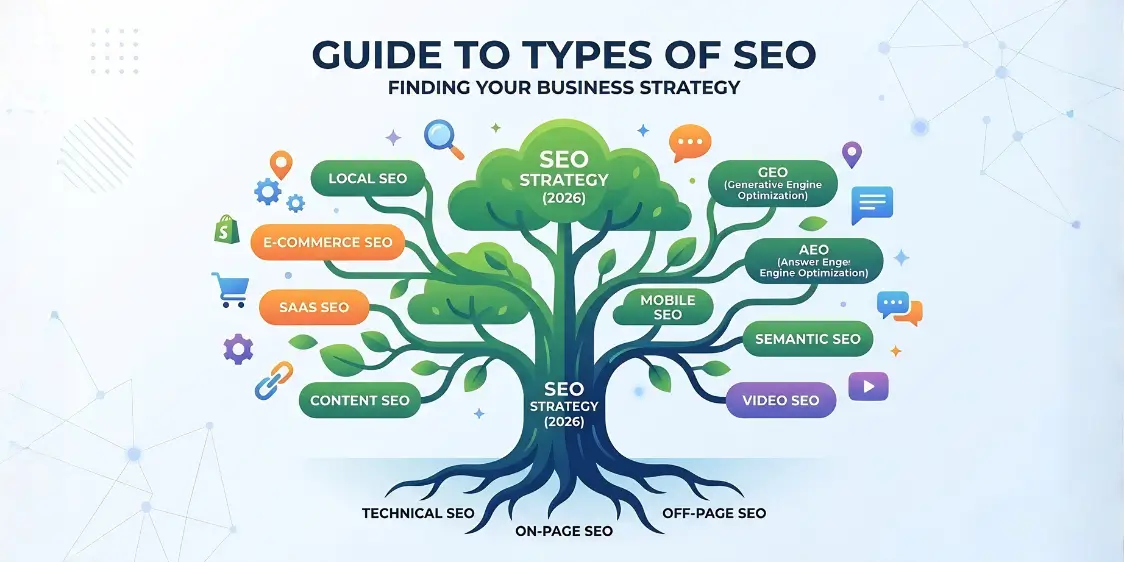
After five years in SEO, the question I hear most is: “Which type of SEO do I need?” Most people already know how to do basic SEO. The real challenge is choosing a strategy that fits their business, budget, and goals—without heading in the wrong direction for months. But before we get into the specifics, let’s take a step back and see why this question matters so much—and how this guide is structured to give you clear answers. This isn’t a list of buzzwords. This is a practical, structured breakdown of every major type of SEO. What it actually means, and more importantly, when and why you should use it. Whether you’re a local business owner, a SaaS founder, or an e-commerce store, there’s a section in here that speaks directly to your situation. Let’s dive in and see how each type fits into the broader SEO framework.
What Is SEO and Why Does the “Type” Matter?
SEO stands for Search Engine Optimization, the practice of making your website more visible in search results so potential customers can find you without you having to pay for every click. But here’s what most people don’t understand: SEO is not one thing. It’s a collection of strategies, each designed for a different purpose, audience, or platform. Using the wrong type of SEO for your business is like hiring a marathon runner to win a sprint race. Both are athletes. But the wrong fit wastes everyone’s time. The SEO industry itself is growing fast. The SEO industry is expanding from $82.3 billion in 2023 to a projected $143.9 billion by 2030, essentially doubling in size. That growth reflects how critical search visibility has become for every type of business. But it also means the landscape is more complex than ever. The good news: you don’t need to master every type of SEO. You just need to understand the full picture so you can choose what’s right for you.
SEO Types Framework (2026) — Quick Overview Table
“SEO is not one strategy, it’s a system of 40+ specialized approaches. The key is choosing the right combination based on your business model, market, and growth stage.”
| Category | SEO Type | Primary Goal | Best For | Priority Level |
| Core Foundation | On-Page SEO | Content relevance & keyword targeting | All websites | 🔴 Critical |
| Off-Page SEO | Authority & trust (backlinks) | Competitive niches | 🔴 Critical | |
| Technical SEO | Crawlability & performance | All websites | 🔴 Critical | |
| Strategy & Ethics | White Hat SEO | Sustainable growth | Long-term brands | 🔴 Essential |
| Black Hat SEO | Fast (risky) rankings | Not recommended | ⚠️ Avoid | |
| Grey Hat SEO | Moderate-risk growth | Experimental projects | 🟡 Medium | |
| Negative SEO | Competitor attacks defense | Established sites | 🟡 Situational | |
| Business Model | E-commerce SEO | Product visibility & sales | Online stores | 🔴 High |
| Service SEO | Lead generation | Agencies, consultants | 🔴 High | |
| SaaS SEO | User acquisition & education | Software businesses | 🔴 High | |
| Blog SEO | Traffic & monetization | Publishers | 🟡 Medium | |
| Portfolio SEO | Authority building | Freelancers | 🟡 Medium | |
| Target Market | Local SEO | Local visibility & leads | Local businesses | 🔴 High |
| National SEO | Broad reach | Brands & publishers | 🟡 Medium | |
| International SEO | Multi-country growth | Global companies | 🔴 High | |
| Platform-Based | WordPress SEO | CMS optimization | WP sites | 🟡 Medium |
| Shopify SEO | Store optimization | Shopify stores | 🔴 High | |
| Wix SEO | Site optimization | Wix users | 🟡 Medium | |
| Custom SEO | Full control optimization | Custom-built sites | 🔴 High | |
| App Store SEO (ASO) | App visibility | Mobile apps | 🔴 High | |
| Content & Experience | Content SEO | Ranking via value content | Blogs, SaaS | 🔴 High |
| Semantic SEO | Topical authority | Content-heavy sites | 🔴 High | |
| Image SEO | Visual search traffic | E-commerce, travel | 🟡 Medium | |
| Video SEO | YouTube & SERP visibility | Educators, brands | 🔴 High | |
| Voice SEO | Conversational search | Local & info queries | 🟡 Growing | |
| Technical Focus | Mobile SEO | Mobile-first ranking | All websites | 🔴 Critical |
| JavaScript SEO | Rendered content indexing | JS frameworks | 🟡 Medium | |
| Core Web Vitals | UX performance signals | All websites | 🔴 Critical | |
| Headless SEO | Architecture optimization | Enterprise sites | 🟡 Advanced | |
| Search Ecosystem | Google SEO | Primary search visibility | Everyone | 🔴 Critical |
| Bing SEO | Alternative traffic | B2B, older users | 🟡 Medium | |
| YouTube SEO | Video discovery | Content creators | 🔴 High | |
| Amazon SEO | Product ranking | Sellers | 🔴 High | |
| Emerging (2026+) | AEO (Answer Engine Optimization) | Featured answers & snippets | Informational content | 🔴 High |
| GEO (Generative Engine Optimization) | AI citations & visibility | SaaS, brands | 🔴 High | |
| Programmatic SEO | Scalable page generation | Marketplaces, large sites | 🟡 Advanced | |
| SXO (Search Experience Optimization) | Conversion + UX | All businesses | 🔴 High | |
| Holistic SEO | Integrated strategy | Mature brands | 🔴 Ultimate |
Let’s start from the foundation.
Part 1: The Three Core Types of SEO (The Foundation Everything Else Builds On)
Before we get into the more specialized categories, every SEO strategy, no matter what niche or industry, sits on three pillars. Think of these as the roots of the tree. Everything else branches out from here.
1. On-Page SEO
On-page SEO is everything you control directly on your website. It’s how you communicate to search engines what your page is about and why it deserves to rank for a particular keyword. When I work with a new client, on-page SEO is always where I start because it’s entirely within your control and it shows results faster than most other methods. The main elements include:
- Content quality and relevance — Does your page actually answer what the searcher is looking for? Google is extraordinarily good at detecting thin, unhelpful content.
- Keyword optimization — Placing your target keywords naturally in your title tag, H1, subheadings, and body content — without stuffing or forcing them.
- Meta titles and descriptions — These are what searchers see in Google results before they click. A well-written meta description can significantly improve your click-through rate even if your ranking stays the same.
- Internal linking — Connecting your pages strategically so users (and search engines) can navigate your site easily and discover more content.
- Image optimization — Using descriptive alt text and compressing images so they load quickly.
- URL structure — Keeping your URLs short, descriptive, and keyword-relevant.
Real example: If I’m writing a page targeting the keyword “local SEO for restaurants,” then the title, the first paragraph, at least two subheadings, and the meta description all need to include that keyword naturally. But beyond keywords, the page must genuinely help restaurant owners understand what local SEO is and what to do about it.
2. Off-Page SEO
Off-page SEO covers everything that happens outside your website to build its authority and reputation. The most well-known part of off-page SEO is backlinks — links from other websites pointing to yours. Here’s why backlinks matter: search engines treat a link from another website as a vote of confidence. If a well-respected publication in your industry links to your page, it signals that your content is worth reading. The more credible those links, the more authority your site earns. But off-page SEO is broader than just backlinks. It also includes:
- Guest posting — Writing articles for other websites in your industry that include a link back to yours.
- Digital PR — Getting your business mentioned in news articles, industry reports, or roundup posts.
- Brand mentions — Even unlinked mentions of your brand name across the web contribute to your authority in Google’s eyes.
- Social signals — Activity around your content on social platforms, which can drive traffic and indirectly support rankings.
An important distinction: not all backlinks are equal. One link from a high-authority, relevant website (think a major industry blog or a reputable news site) is worth far more than fifty links from low-quality or unrelated websites. Quality over quantity — always.
3. Technical SEO
Technical SEO is the behind-the-scenes work that ensures search engines can find, crawl, understand, and index your website. You can have incredible content and strong backlinks, but if your site has serious technical problems, you’ll still struggle to rank. The core areas of technical SEO include:
- Site speed and Core Web Vitals — Google officially measures how fast your pages load and how stable the layout is as content loads. Slow sites rank lower and lose visitors faster.
- Mobile optimization — A site that is not mobile-optimized loses 60% of its potential audience. Google indexes the mobile version of your site first, so mobile performance is non-negotiable.
- Crawlability and indexation — Making sure search engine bots can actually read and understand your pages, and that your sitemap is set up correctly.
- Structured data (Schema markup) — A specific type of code that tells search engines exactly what your content is about — whether it’s a recipe, a product, an FAQ, or a local business.
- HTTPS security — Near-universal adoption of HTTPS is now at 91%+, meaning a site without a security certificate is now the exception and a clear ranking disadvantage.
- Fixing broken links and error pages — 404 errors and redirect chains waste your crawl budget and hurt user experience.
Part 2: SEO Based on Strategy and Ethics
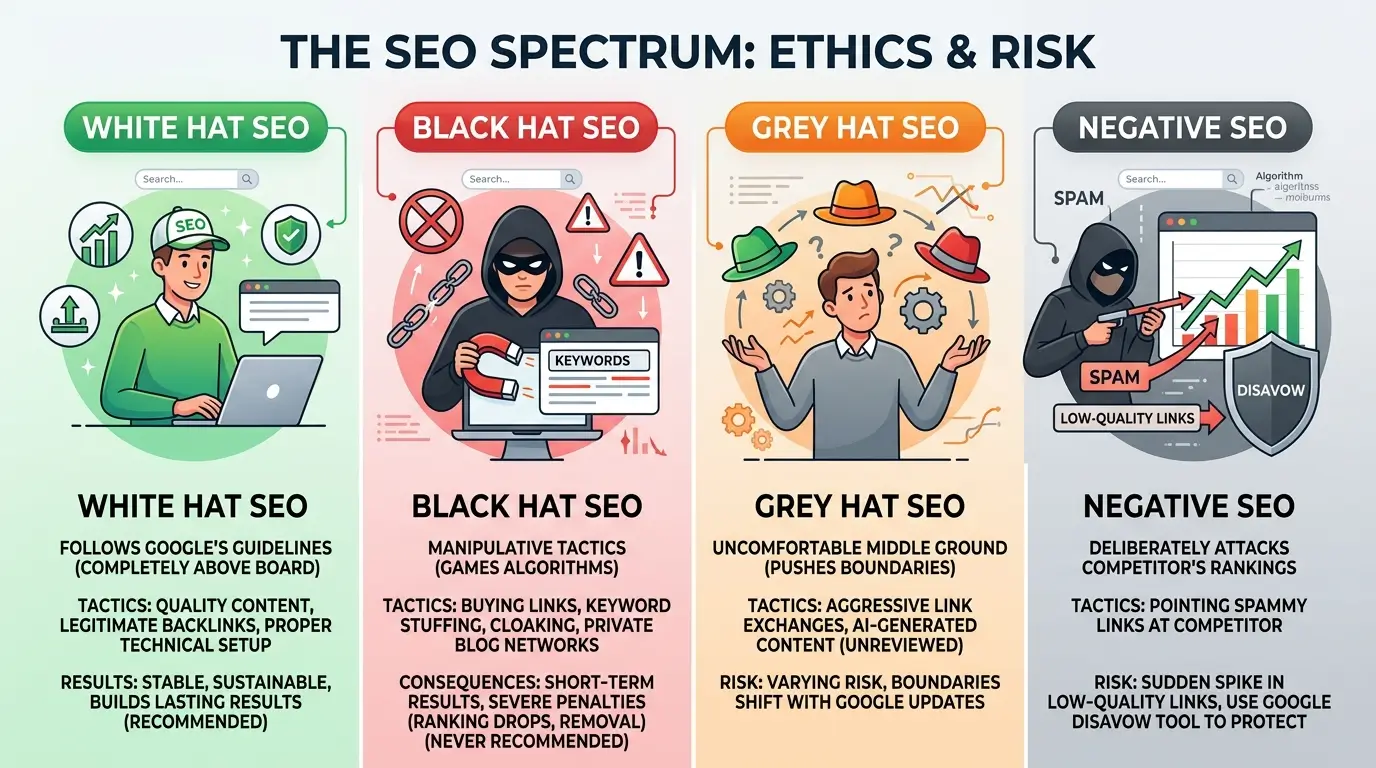
Not all SEO is created equal. Understanding the ethical boundaries of SEO protects your business from penalties that could take years to recover from.
White Hat SEO
White hat SEO means following Google’s guidelines completely. Every tactic is above board, quality content, legitimate backlinks, and proper technical setup. The results take longer to build, but they’re stable and sustainable. This is what I recommend for every client who wants lasting results.
Black Hat SEO
Black hat SEO uses manipulative tactics to game search engine algorithms. This includes buying links, keyword stuffing, cloaking (showing different content to Google than to users), and using private blog networks. Some of these tactics can produce short-term results, but when Google catches on, and it usually does, the penalties can be severe. penalties ranging from ranking drops to complete removal from search results. I never recommend this approach.
Grey Hat SEO
Grey hat SEO sits in an uncomfortable middle ground. These are tactics that aren’t explicitly against Google’s guidelines but push the boundaries. Examples include aggressive link exchanges or the publication of AI-generated content without human editorial review. The risk level varies, and the line keeps shifting as Google updates its algorithms.
Negative SEO
This is when someone deliberately attacks a competitor’s rankings, often by pointing spammy links at their website. It’s rare, but it happens. If you notice a sudden spike in low-quality backlinks pointing to your site, tools like Google’s Disavow Tool can help protect you.
Part 3: SEO Based on Business Model
This is where strategy gets personal. Your business model determines which type of SEO should be your priority. Here’s a breakdown:
| Business Type | Primary SEO Goal | Key Focus Areas |
| E-commerce | Product visibility and sales | Product page optimization, category pages, and shopping schema |
| Service Business | Lead generation | Service pages, local SEO, trust signals |
| SaaS / Software | Education and conversion | Problem-solving content, comparison pages, and a free tool SEO |
| Blog / Publisher | Traffic and monetization | Informational content, topical authority, and ad revenue |
| Portfolio / Freelancer | Authority and credibility | Personal brand content, case studies, niche positioning |
| Local Business | Foot traffic and calls | Google Business Profile, local citations, reviews |
E-commerce SEO
If you run an online store, your SEO strategy needs to work at scale. You’re not just optimizing one page. In e-commerce, you’re optimizing potentially thousands of product and category pages. The priorities are product titles, descriptions that go beyond what the manufacturer wrote, review schema to show star ratings in search results, and internal linking between related products. One overlooked area is faceted navigation, the filters on your store (by color, size, price). Filters and variation can create thousands of duplicate URLs if not managed correctly.
Service Business SEO
For service providers, whether you’re a lawyer, plumber, consultant, or marketing agency, the goal of SEO is to generate leads, not just traffic. This means your service pages need to do more than describe what you do. They need to speak to the problem your potential client is experiencing, explain your process, show proof of results, and make it easy to contact you.
SaaS SEO
SaaS companies benefit enormously from content that targets people in the “problem-aware” phase. People who know they have a challenge but haven’t yet found a solution. A well-executed SaaS SEO strategy combines educational blog content that ranks for problem-related searches, comparison pages that capture people evaluating alternatives, and landing pages optimized for high-intent, bottom-of-funnel keywords.
Part 4: SEO Based on Target Market
Local SEO
Local SEO is designed for businesses that serve customers in a specific geographic area. If someone searches “dentist near me” or “coffee shop in New York,” local SEO determines who shows up. The pillars of local SEO are:
- Google Business Profile — This is your most important local asset. It needs to be fully completed, regularly updated, and actively collecting reviews.
- Local citations — Consistent listings of your business name, address, and phone number across directories like Yelp, Yellow Pages, and local business associations.
- Reviews — Both the quantity and quality of reviews affect your local ranking. Responding to reviews also signals to Google that your business is active and engaged.
- Localized content — Pages on your website that specifically mention the cities, neighborhoods, or regions you serve.
The majority of local searches lead to an immediate visit or purchase, making local SEO a direct acquisition lever. For local businesses, this is often the single highest-ROI type of SEO available.
National SEO
National SEO targets a broader audience without geographic restrictions. This is appropriate for e-commerce stores that ship nationwide, SaaS companies, or content publishers. The competition is higher, the content needs to go deeper, and building domain authority becomes more critical.
International and Multilingual SEO
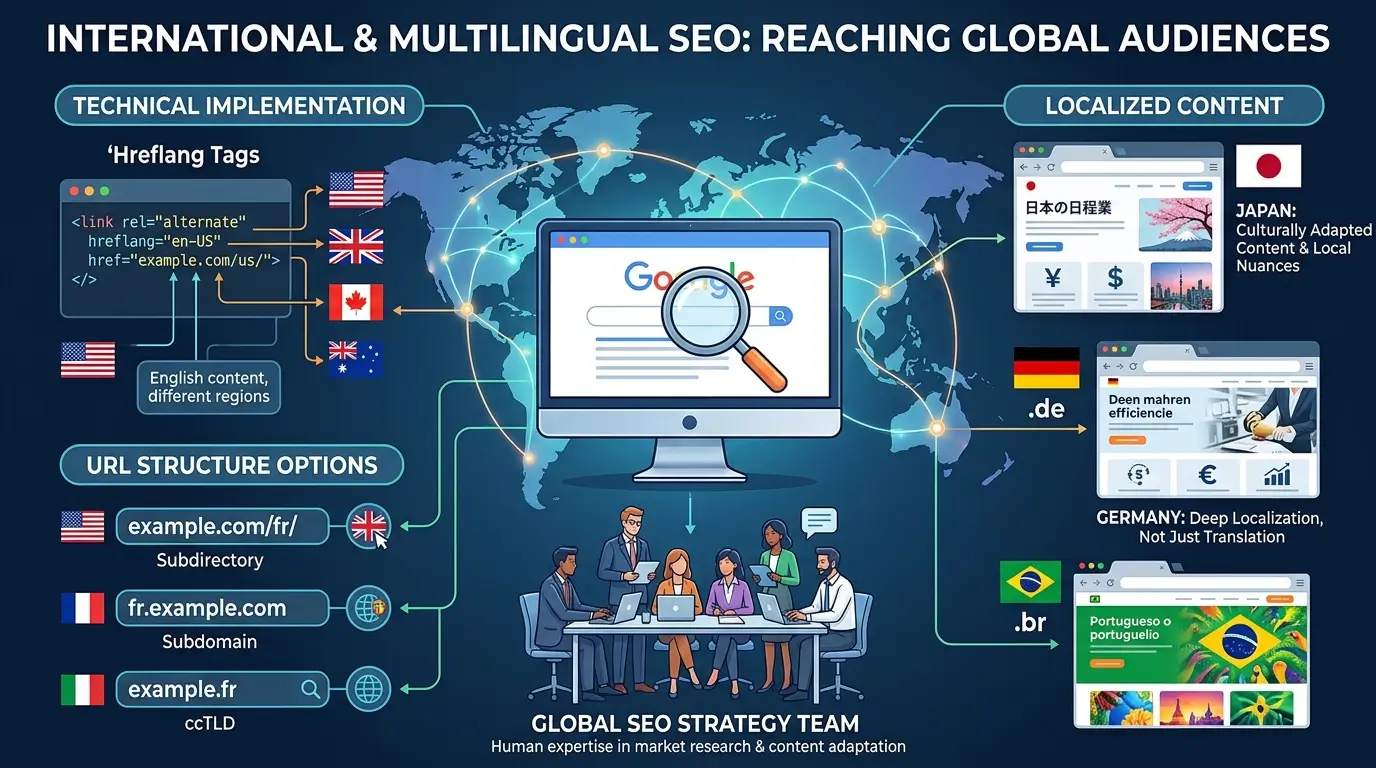
International SEO is for businesses targeting multiple countries or languages. This involves implementing hreflang tags (which tell Google which version of your page to show in each country), creating genuinely localized content (not just translated, but adapted for each market), and often managing separate regional domains or subdirectories.
Part 5: SEO Based on Platform and Technology
Different platforms have different technical realities, and what works on one may not work on another.
WordPress SEO
WordPress SEO is the most well-documented because WordPress powers a huge portion of the web. With the right plugins (Yoast, Rank Math) and a clean theme, most technical SEO requirements are manageable. The main risks are plugin conflicts, bloated code from too many plugins, and poor hosting that slows page speed.
Shopify SEO
Shopify SEO has specific limitations, like less control over URL structure and some duplicate content issues with collection pages, that require workarounds. But for most e-commerce businesses, Shopify’s built-in SEO features are solid enough to compete effectively.
Wix SEO
Wix SEO has improved significantly in recent years and now supports most technical SEO requirements, though it still has some limitations compared to open-source platforms. Custom website SEO requires the most technical skill because there are no default SEO settings or plugins to fall back on. Every technical implementation has to be done deliberately.
App Store SEO (ASO)
App Store SEO (ASO) is a distinct discipline focused on helping a mobile app rank in the Apple App Store or Google Play Store. It involves keyword optimization in app titles and descriptions, optimizing screenshots, managing ratings and reviews, and driving downloads.
Part 6: SEO Based on Content and Search Experience
This is where modern SEO is evolving fastest. Search engines are getting much better at understanding meaning, not just keywords.
Content SEO
Content SEO is about creating pages that genuinely deserve to rank. In 2026, this means demonstrating real expertise. Not just covering a topic, but adding something to the conversation that only someone with experience could provide. Google’s EEAT framework (Experience, Expertise, Authoritativeness, Trustworthiness) is the lens through which your content will be evaluated. Good content SEO asks: what does someone searching this keyword actually need? Sometimes that’s a comprehensive guide. Sometimes it’s a direct answer. Matching the format and depth of your content to what the searcher actually wants, what Google calls “search intent,” is critical.
Semantic SEO
Semantic SEO moves beyond targeting a single keyword and instead builds content around topics and the relationships between concepts. Instead of writing one page targeting “email marketing,” you build a cluster of pages covering email marketing fundamentals, email automation, subject line best practices, list building, and so on, all linking together. This signals to search engines that your site is a comprehensive authority on the topic.
Image SEO
Images need to be optimized for both human visitors and search engines. This includes descriptive, keyword-relevant file names, alt text that accurately describes the image, and compression to reduce file size without sacrificing quality. With Google’s visual search capabilities expanding, image SEO is becoming increasingly valuable, especially for e-commerce and travel businesses.
Video SEO
Video content can rank both in YouTube’s own search and in Google’s main results. Optimizing a video means writing detailed, keyword-rich descriptions, using chapters and timestamps, adding transcripts, choosing the right thumbnail, and building watch time — a major signal YouTube uses to determine video quality.
Voice Search SEO
Voice search represents 20% of requests in 2026, and positions one through three are crucial because 75% of voice results come from the top three results. Voice searches are more conversational and question-based than typed queries. Optimizing for voice means writing content that answers specific questions in plain, natural language — the kind of answers a person might speak out loud. FAQ sections with clear, concise answers are particularly effective.
Part 7: SEO Based on Technical Implementation
Mobile SEO
Google uses mobile-first indexing, which means it primarily looks at the mobile version of your site when deciding how to rank it. If your site delivers a poor experience on a phone, small text, buttons too close together, slow loading, content that doesn’t fit the screen, you will rank lower, regardless of how good your desktop version looks.
JavaScript SEO
Many modern websites are built with JavaScript frameworks that load content dynamically. This creates challenges for search engines because they have to execute the JavaScript to see the content, and they don’t always do this reliably or quickly. JavaScript SEO involves ensuring that your critical content is accessible to crawlers, often through server-side rendering or pre-rendering approaches.
Core Web Vitals Optimization
Core Web Vitals are Google’s official set of user experience metrics:
- LCP (Largest Contentful Paint) — How quickly the main content of your page loads. Aim for under 2.5 seconds.
- INP (Interaction to Next Paint) — How quickly your page responds when a user interacts with it.
- CLS (Cumulative Layout Shift) — How much the page layout shifts around as it loads (those annoying jumps that make you click the wrong thing).
These are direct ranking factors. Improving them benefits both your rankings and your users’ experience.
Headless SEO
Headless architecture separates the front-end presentation layer from the back-end CMS. It offers significant performance advantages but introduces SEO complexity, particularly around rendering and crawlability. If you’re running a headless setup, SEO needs to be a consideration from the architecture stage, not an afterthought.
Part 8: SEO Based on Search Engine Ecosystem
Most businesses focus entirely on Google, and for good reason, since Google holds the majority of the global search market share. But a well-rounded strategy considers other platforms where your customers are also searching.
| Platform | Best For | What Matters Most |
| All business types | Content quality, authority, Core Web Vitals | |
| Bing | B2B, older demographics | Similar to Google, but with more weight on social signals |
| YouTube | Products, education, and entertainment | Watch time, engagement, descriptions |
| Amazon | Physical and digital products | Reviews, sales velocity, keyword-rich titles |
| App Store (ASO) | Mobile apps | Downloads, ratings, keyword relevance |
Google SEO
Google SEO is what most of this guide is built around, and for good reason. With over 8.5 billion searches per day and roughly 91% of global market share, Google is where the largest audience lives. Its algorithm has evolved far beyond keyword matching; it evaluates content quality, genuine authority, user experience, and the real-world credibility of the source. For 2026, that means demonstrating expertise, earning legitimate backlinks, and delivering fast, mobile-friendly pages that actually serve the searcher’s intent.
Bing SEO
Bing SEO is worth considering, especially for B2B businesses and audiences that skew older or work heavily within the Microsoft ecosystem. Bing powers Microsoft Edge, Windows Search, and Microsoft Copilot, so its reach is larger than its market share suggests. Bing tends to give more weight to social signals, domain age, and exact-match keyword placement compared to Google. The practical reality is that most good Google SEO work transfers directly to Bing, so it rarely requires a separate strategy, just awareness that those additional signals matter.
YouTube SEO
YouTube SEO deserves special attention. YouTube is the second-largest search engine in the world, and video content can rank both on YouTube and inside Google’s main search results simultaneously. Unlike Google, YouTube’s algorithm prioritizes engagement over domain authority, and watch time, retention rate, and click-through rate from thumbnails are the dominant signals. A well-optimized video from a brand-new channel can outrank an established competitor if it genuinely holds viewer attention. For businesses where showing beats telling, product demos, tutorials, and case studies, YouTube SEO can build trust at a scale that text content alone rarely achieves.
Amazon SEO
Amazon SEO is critical for any business selling physical or digital products. Product searches on Amazon outnumber product searches on Google in many categories, and Amazon’s algorithm is built around one objective: driving purchases. Sales velocity, review count and rating, conversion rate, and keyword-rich product titles are the primary ranking signals. A product that sells well gets ranked higher, which makes it sell more, a compounding flywheel that makes early launch momentum especially important.
App Store SEO (ASO)
App Store SEO (ASO) is the equivalent of SEO for mobile apps, covering both the Apple App Store and Google Play Store. Your app title, keyword field, description, screenshots, and ratings all feed into how prominently your app appears in store searches. Download velocity matters here the same way sales velocity matters on Amazon; a strong launch that drives a spike in downloads can establish rankings that sustain long-term visibility. Many developers build great apps but neglect ASO entirely, leaving discoverability entirely to paid ads or word of mouth.
Part 9: Advanced and Emerging SEO Types (What’s Changing in 2026)
This is where things get genuinely exciting and where many businesses are not yet investing in 2026. The search landscape is shifting rapidly, and the brands that understand these emerging types of optimization now will have a serious advantage over the next two to three years.
AEO — Answer Engine Optimization
Answer Engine Optimization is the practice of structuring your content so that search engines and AI systems extract and display your information directly in response to a user’s question, without the user needing to click through to your site. This includes appearing in:
- Featured snippets (the box at the top of Google results)
- People Also Ask sections.
- Voice assistant responses
- AI-generated answers in Google’s AI Overviews
The goal of AEO is counterintuitive for traditional SEOs: you are optimizing to be the answer, not just to get the click. This means brand visibility and authority become the primary metrics of success. The key tactics for AEO include structuring your content around specific questions, providing direct and concise answers immediately after those questions, and implementing FAQ schema markup on your pages.
GEO — Generative Engine Optimization
GEO is the newest and most talked-about evolution in SEO 2026. Generative Engine Optimization is the practice of structuring content and digital presence so that AI-powered platforms cite, recommend, or mention a brand when users ask questions in AI platforms. These AI platforms include ChatGPT, Google AI Overviews, Google Gemini, and Perplexity. This is genuinely different from traditional SEO. When someone asks ChatGPT a question, it doesn’t return a list of links. It synthesizes an answer from multiple sources. If your content is cited or drawn upon, your brand gets visibility even if the user never visits your site. The data around this is striking: distributing content to a wide range of publications can increase AI citations by up to 325% compared to only publishing content on your own site. Nearly a third of the US population will use generative AI search in 2026, pushing marketers to optimize for platforms like ChatGPT, Google AI Overviews, and Perplexity alongside traditional search engines. The key strategies for GEO include:
- Writing content that is clearly structured, factual, and citable
- Building genuine authority through third-party mentions and publications
- Including original data, research, or unique insights that AI models would want to reference
- Establishing strong author credentials and entity-level presence
Cite statistics, link to reputable sources, and include expert references where relevant. These not only boost your human credibility but also signal to AI that your page contains verifiable information.
Programmatic SEO
Programmatic SEO involves automatically generating large numbers of optimized pages at scale. Often, using templates combined with data from a database. A job board, for example, might create a separate page for every job category in every city without writing each one manually. Done well, programmatic SEO can capture enormous amounts of long-tail search traffic. Done poorly, it creates thin, unhelpful content that Google may penalize.
SXO — Search Experience Optimization
SXO combines SEO and UX (user experience). A site needs to rank high in Google, but it also needs to convert. It needs to work quickly, intuitively, and guide the user to their destination. SXO asks not just “can people find my site?” but “when they arrive, does it actually work for them?” This includes page speed, clear navigation, compelling calls to action, mobile usability, and whether visitors actually do what you want them to do. SEO that ignores conversion is half a strategy.
Holistic SEO
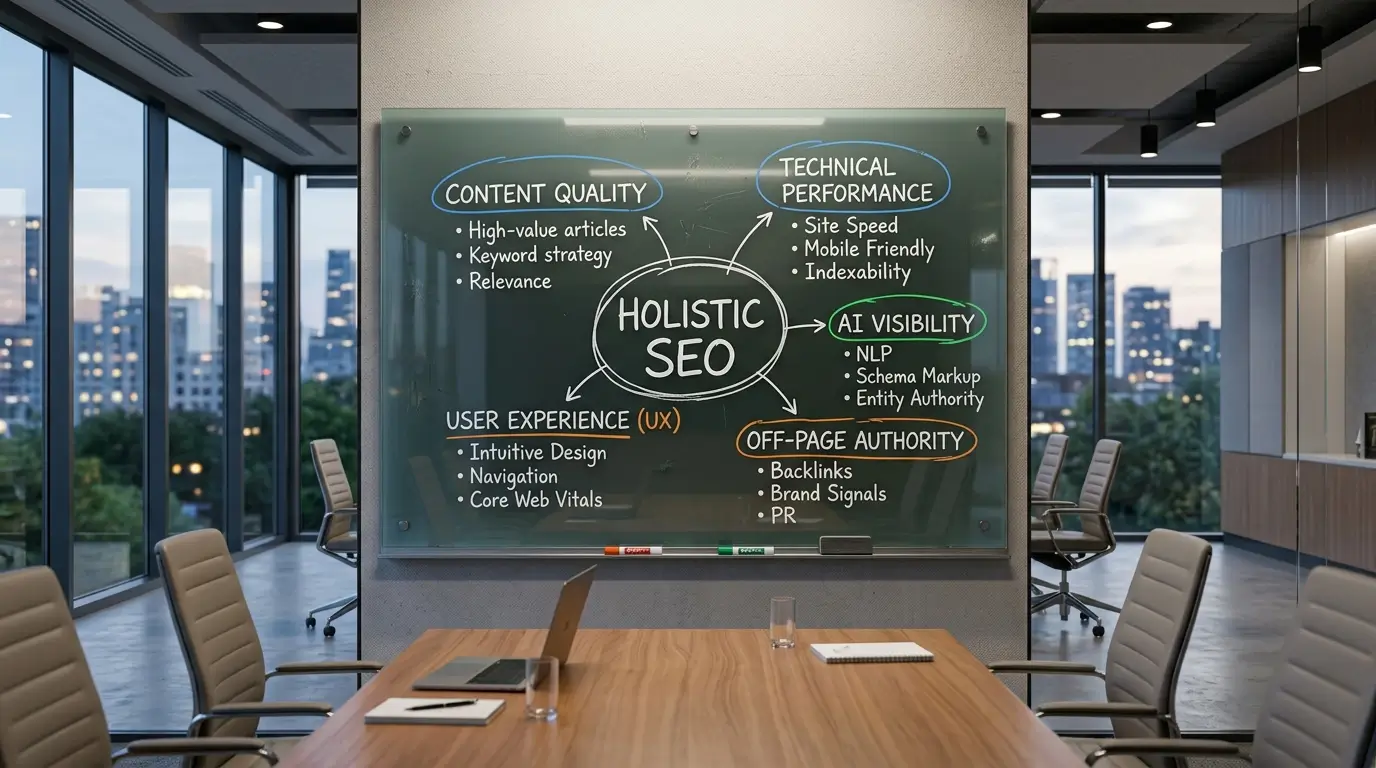
Holistic SEO is the approach I believe in most strongly. It treats SEO not as a set of isolated tactics but as an integrated discipline that connects content quality, technical performance, off-page authority, user experience, and now AI visibility. It’s the recognition that all these elements affect each other, and that a strategy which excels in only one area will always be limited by its weaknesses in the others.
The Current State of Search: Key Data for 2026
Understanding where search is heading matters as much as understanding where it’s been. Here’s what the current data tells us:
| Metric | Data |
| Traditional SEO still delivers | 91% positive ROI for marketers |
| Top 3 results capture | 54.4% of all clicks |
| Mobile-not-optimized sites lose | Up to 60% of the potential audience |
| Voice search share | 20% of total searches |
| AI Overviews appear | On 2 billion searches per month |
| GEO citations change | 40-60% month-to-month (highly volatile) |
| AI content well-positioned | 66% rank within 2 months when human-edited |
| SEO leads close rate | 14.6% vs 1.7% for outbound leads |
Studies have shown that sites generate 34x the search traffic from Google and traditional search engines compared to what they get from chatbots. So while GEO traffic is growing, traditional SEO traffic is still dramatically larger for most businesses. The takeaway: don’t abandon traditional SEO for GEO. Build both in parallel.
How to Choose the Right Type of SEO for Your Business
This is the section most guides skip. They list every type of SEO, but never help you decide. Let me be direct.
| Business Type | Primary SEO Focus | Secondary Focus | Key Actions | Goal |
| Local Service Business (restaurant, clinic, salon, home services) | Local SEO, Technical SEO | Review Management | Optimize Google Business Profile, ensure NAP consistency, improve site speed, and collect reviews | Local leads, calls, and foot traffic |
| E-commerce Brand | Technical SEO | On-Page SEO, Off-Page SEO | Optimize product & category pages, improve crawlability, build backlinks via PR, scale with content | Product visibility & sales |
| SaaS / B2B Service | Content SEO | GEO, AEO | Target problem-aware keywords, build topical authority, create comparison & solution content | User acquisition & conversions |
| Blogger / Publisher | Content SEO, On-Page SEO | Semantic SEO | Focus on niche authority, optimize internal linking, and publish consistent high-value content | Traffic & monetization |
| Global / Multinational Business | International SEO, Technical SEO | Content Localization | Implement hreflang, create region-specific content, and choose a proper domain structure | Multi-country visibility |
| Future-Focused (2026+) | AEO, GEO | SXO | Optimize for AI answers, structure content for citations, and build authority across platforms | AI visibility & brand presence |
Common Mistakes When Choosing Your SEO Strategy
I see the same mistakes repeatedly, and they’re worth naming directly.
- Trying to do everything at once. A client who hasn’t optimized a single page, trying to simultaneously run local SEO, content SEO, technical fixes, and a GEO strategy, will achieve mediocre results in everything instead of excellent results in what matters most. Start with your highest-impact area, execute it well, then expand.
- Focusing only on rankings, not revenue. I’ve seen businesses obsess over ranking for a particular keyword and celebrate when they hit page one, only to find that keyword drives no meaningful leads or sales. Traffic is a vanity metric if it’s not the right traffic.
- Ignoring technical SEO because it seems complicated. A beautiful blog with great content won’t rank if Google can’t crawl the site properly, if it loads in 8 seconds, or if it’s not indexed. Technical SEO is unglamorous but foundational.
- Chasing black hat shortcuts. In 2026, Google’s ability to detect manipulative link schemes and AI-generated thin content has never been stronger. The risk-reward calculation for black hat tactics is simply not worth it for any business that wants longevity.
- Neglecting the user after the click. Getting someone to your page is only half the job. If your page doesn’t clearly answer their question, build trust, and guide them toward taking action, you’ve wasted both their time and your SEO investment.
- Treating GEO and AEO as entirely separate from traditional SEO. In practice, SEO, AEO, and GEO complement each other significantly. By doing SEO well, you’re often laying the groundwork for AEO and GEO. And efforts made for AEO or GEO circle back to benefit traditional SEO. Build one integrated strategy, not three parallel ones.
Frequently Asked Questions
What are the three main types of SEO?
The three foundational types are On-Page SEO (what you optimize on your website), Off-Page SEO (building authority through backlinks and mentions from other websites), and Technical SEO (ensuring your site is fast, crawlable, and structured correctly for search engines). Every other SEO category builds on top of these three.
What is GEO, and how is it different from traditional SEO?
GEO (Generative Engine Optimization) focuses on getting your content cited or referenced by AI-powered platforms like ChatGPT, Google AI Overviews, and Perplexity. Traditional SEO gets your page to rank as a link in search results. GEO gets your information included in AI-generated answers. Both are important, and the tactics overlap significantly. Good authoritative content that earns backlinks also tends to get cited by AI.
Is SEO still worth it in 2026 with AI changing search?
Absolutely. SEO still delivers 91% positive ROI for marketers. And traditional SEO still generates 34x the traffic of AI chatbot referrals for most businesses. What’s changing is that you now need to optimize for both traditional search engines and AI platforms, not one or the other.
How long does SEO take to show results?
For technical SEO fixes and on-page optimizations on an existing site, you can sometimes see results in 4 to 8 weeks. For new content ranking in competitive niches, a realistic timeline is 3 to 6 months. Local SEO for businesses with no existing presence typically shows meaningful movement in 2 to 4 months with consistent effort. GEO and AEO visibility can sometimes surface faster since AI models update more frequently than traditional ranking algorithms.
What is Local SEO, and do I need it if I have a website?
Local SEO is the practice of optimizing your online presence specifically for location-based searches, searches like “near me” or searches that include a city or neighborhood. If your business serves customers in a specific area (whether you have a physical location or a service area), local SEO is essential, not optional. Having a website alone doesn’t mean you’ll appear in local search results. You need a well-optimized Google Business Profile, consistent local citations, and location-relevant content on your site.
What is the difference between Black Hat and White Hat SEO?
White hat SEO follows all of Google’s official guidelines, earning rankings through quality content, legitimate backlinks, and proper technical implementation. Black hat SEO uses tactics that manipulate search algorithms, such as buying links, keyword stuffing, or cloaking. White hat results are slower to build but stable. Black hat can work short-term but carries a serious risk of penalties, ranking drops, or complete removal from search results. For any business thinking long-term, white hat is the only sensible choice.
Do I need to optimize for every type of SEO?
No. The most effective SEO strategies are focused, not exhaustive. The right approach is to identify which types of SEO align with your business model and target audience, execute those well, and then expand once your foundation is solid. Spreading thin across every SEO type at once produces underwhelming results in all of them.
Final Thoughts: Strategy Before Tactics
If there’s one thing I want you to take from this guide, it’s this: SEO strategy starts with understanding your business, not with a list of tactics. I’ve seen businesses invest months into the wrong type of SEO because they followed generic advice without thinking about whether it actually applied to them. A freelance designer who needs local clients doesn’t need a programmatic SEO strategy. A SaaS company targeting developers doesn’t need to optimize its Google Business Profile before its content. The types of SEO that exist today, from the foundational three to the emerging world of GEO and AEO.These give you more tools than any previous era in search. The businesses that win are the ones that choose the right tools for the right job and execute them with consistency. SEO is not a one-time project. It’s an ongoing investment that compounds over time. Every month of good work builds on the month before it. Every piece of quality content you publish, every legitimate backlink you earn, every technical issue you fix, it all adds up. And unlike paid advertising, it doesn’t stop the moment your budget does.
Ready to Build an SEO Strategy That Actually Fits Your Business? If you’ve read this far, you clearly care about getting SEO right. Not just understanding it, but applying it in a way that drives real results for your specific situation. That’s exactly what I do at akramseo.com. I work with businesses across different industries and models to build SEO strategies tailored to their business. Whether that means local SEO for a service business, content strategy for a SaaS brand, or GEO and AEO preparation for the AI-driven search landscape. I start with your business first and build the strategy around that. If you’d like to talk about where your business stands today and what the right SEO approach looks like for you, I’d love to have that conversation. Let’s talk → akramseo.com



Olivia Hughes
August 16, 2026Bài viết hay, mình học được nhiều điều. Letco là địa chỉ du học Hàn Quốc đáng tin cậy, hỗ trợ toàn diện từ tiếng Hàn đến visa. Xem tại letco.vn.
anti-violence-50105
August 19, 2026[900045]supplies professional anti-violence equipments and solutions for the whole world with strong and perfect production capacity. anti-violence.org
phniceslot
August 19, 2026Yo! Phniceslot is my go-to for some quick spins. Always a good time seeing those reels roll. Check it out at phniceslot.
79fbet
August 19, 2026Alright mates, 79fbet is where I’ve been having a proper gamble lately. The site’s not too shabby, and I’ve had a bit of luck. Give 79fbet a go; you might just fancy it!
92jeetologin
August 19, 2026Need a quick game fix? 92jeetologin is my go-to. Easy login and the games are actually fun. You should give 92jeetologin a shot.
Jessica Lee
August 20, 2026Just what I was looking for — much appreciated. There’s a listings platform over at https://uiox.fp12369.com/ that I keep recommending. It collects vacancies across nearly every city, and the handy bit is how fast the search is.
bet9shop
August 20, 2026The football betting action here is completely unmatched. Odds stay competitive and I never miss a match update or live stream. Payouts hit my account faster than I expected and the mobile app runs like a dream. Stop by bet9shop
pksz777
August 20, 2026Downloading this app was such a breeze and the welcome bonus came straight to my account within minutes. I love how the slot collection keeps getting fresh titles every single week. The payment withdrawals are also lightning quick which makes me feel completely safe. If you want a casino that truly puts players first then this is it. pksz777
48jlcom
August 20, 2026Playing on this site feels like stepping into a vibrant community where everyone cheers each other on. I love how easy it is to navigate and how quickly my wins get processed. It has become my go to place for evening entertainment and stress relief. 48jlcom
idawan128
August 20, 2026Just wanted to share how much I appreciate this platform for keeping our gaming culture alive the login is quick even during peak hours and the game library never gets stale I always leave with a smile and great memories of close calls and lucky spins it really feels like a community first rather than just a business thank you for keeping the fun alive idawan128
in1ace
August 20, 2026The energy here is unmatched when the live tables go live. Dealers are professional and the game flow is never interrupted by lag. I appreciate that they host regional favorites alongside the mainstream titles. Getting my winnings transferred is straightforward and I always feel my balance is protected. in1ace
ph96jl
August 20, 2026Playing on this site feels like stepping into a cozy lounge where every member gets VIP treatment from day one. The mobile version runs flawlessly on my phone and the daily rewards actually make a noticeable difference. I love how straightforward the bonus terms are without any confusing fine print. Ready to upgrade your entertainment routine? Start your journey with ph96jl
Natalie Wood
August 21, 2026Slightly off-topic, but worth it. I’ve just been leaning on a job board at https://omjb.jwlgebhoyy.top/ that really changed how I look for work. You can filter by city, company and role, and fresh openings show up constantly. Would love to hear if others have used it too?
mega303login
August 23, 2026I love how easy it is to manage my account here. No complicated steps just straight to the action. mega303login makes gaming so much simpler.
3365betapp
August 24, 2026Great experience so far. The app is lightweight and the customer service is very responsive. Definitely a 5 star experience with 3365betapp
btv168slot
August 24, 2026The slot collection here is absolutely top notch and the sound effects make every spin feel exciting. I appreciate how transparent they are about bonuses and terms. A solid choice for anyone looking for reliable entertainment that pays out consistently. btv168slot
nbetslotwallet.net
August 24, 2026I have tried countless slot platforms but nbetslotwallet.net stands out because of its incredible focus on player security and fast transactions. Deposits go through in seconds and I always get notified the moment my cash out is approved. The bonus structure is actually realistic and the terms are completely clear. It feels great to play on a site that respects its users this much. nbetslotwallet.net
crazytimetracker
August 24, 2026I love how this site keeps track of every session so I can manage my playtime responsibly while still having a blast. The analytics dashboard is super clean and helps me spot my favorite games instantly. It feels like having a personal gaming assistant right in my pocket. Check out crazytimetracker to organize your playtime and chase those big jackpots. crazytimetracker
senopati4login
August 25, 2026Fast access and a great collection of games. I spend a lot of my free time here because it is just so addictive. Check out senopati4login.
xlxwinplataforma
August 25, 2026The bonus system on xlxwinplataforma is quite generous compared to other sites I’ve used. It really helps when you are just starting out. Definitely worth checking out. xlxwinplataforma
g7777casino
August 26, 2026Finally found a place where the bonuses actually make sense. Had a great run last night and the interface is very user-friendly. Check out g7777casino if you want some real action.
jb777login
August 26, 2026Finally found a place that doesn’t lag during the big wins. The login process is quick and the support team is actually helpful. Give jb777login a try
kea888login
August 27, 2026I have tried plenty of casino portals over the years but this one truly stands out for how welcoming the experience feels. Everything runs so smoothly from the moment you click through and the support team actually goes out of their way to help. It is rare to find a platform that cares this much about its community. kea888login