
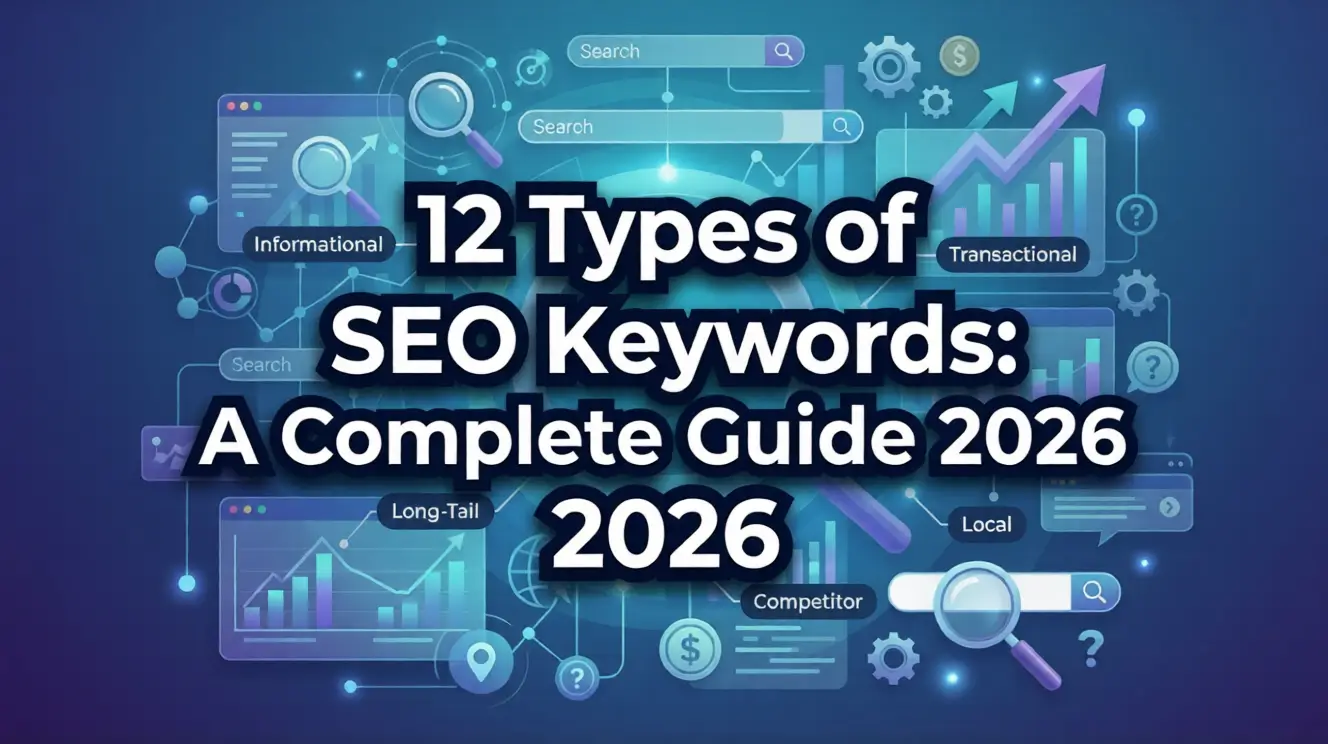

A keyword is not just a word. It is a window into what a person is thinking, what they need, and how close they are to taking action. When you understand that, keyword research stops feeling like a guessing game and starts feeling like a conversation with your future customers.
As we have discussed SEO types before, now it’s time to disclose types of SEO keywords. In this guide, I am going to walk you through every major type of SEO keyword, what each one means, real examples, and most importantly, which types actually matter for your business. Whether you are a business owner, a marketing manager, an e-commerce founder, or someone who makes decisions about digital growth, this is the guide I wish someone had put in front of me when I started.
What Are SEO Keywords and Why Do They Matter?
SEO keywords are the words and phrases people type into search engines when they are looking for something. Your job as a business is to make sure your website shows up when people type words that are relevant to what you offer.
Here is why this matters more than most people realize. Organic search, meaning people finding you through a search engine without you paying for the click, drives somewhere between 50% and 70% of all website traffic across industries. That traffic does not cost you anything per click. And unlike paid advertising, a page that ranks well keeps bringing you visitors week after week without additional spend.
But here is the catch: not all keyword traffic is equal. Someone searching “what is search engine optimization” is in a completely different headspace than someone searching “hire seo specialist for e-commerce.” Both are using keywords related to SEO. But one is a student doing research, and one is a potential client ready to spend money. If you only chase volume and ignore context, you will attract a lot of the first person and very few of the second.
That distinction comes down to understanding keyword types. Let me break them down one by one.
Part 1: Keywords by Search Intent (The Most Important Category)
Search intent is the reason behind a keyword. It answers the question: What does this person actually want right now? Google has built its entire modern algorithm around understanding intent, and in 2026, this is the single most important dimension of keyword strategy.
There are four main types of intent, and knowing them changes how you create content entirely.

1. Informational Keywords
These are searches where someone wants to learn something. They have a question, a problem, or a curiosity, and they want an answer. They are not ready to buy yet. They are gathering information.
Examples:
- “What is local SEO”
- “How does a website rank on Google”
- “Why is my website not getting traffic”
- “What are core web vitals”
Informational keywords are high volume and low conversion. Meaning a lot of people search them, but very few are going to pull out their credit card immediately after reading your answer. So why target them at all?
Because they build trust. When someone reads your content, gets a genuinely helpful answer, and walks away thinking “this person clearly knows what they are talking about,” you have planted a seed. When they are eventually ready to hire someone or buy something, they come back to you. This is how content marketing compounds over time.
For business owners, informational content is your top-of-funnel investment. Do not expect immediate leads. Expect long-term authority.
2. Navigational Keywords
Navigational searches happen when someone already knows where they want to go. They are using Google as a shortcut to reach a specific website, brand, or page.
Examples:
- “Semrush login”
- “akramseo.com portfolio”
- “Ahrefs keyword explorer”
- “Nike official website”
If someone is searching your brand name, that is a navigational keyword. These are signals of existing brand awareness and loyalty. You should absolutely rank for your own brand name and key pages, but you cannot build a growth strategy entirely on navigational searches because they only reach people who already know you exist.
Where navigational keywords become strategically interesting is when people search your competitor’s brand name. If someone types “Semrush alternative” or “Ahrefs vs,” they are navigating toward a category but are open to options. These are valuable keywords for positioning content.
3. Commercial Keywords
Commercial keywords are searched by people who are actively researching before making a decision. They know roughly what they want. They are comparing options, reading reviews, and evaluating which product, service, or provider is the right fit.
Examples:
- “best SEO tools for small business”
- “top email marketing platforms 2026”
- “Semrush vs Ahrefs comparison”
- “SEO agency reviews”
These are extremely valuable keywords for businesses because the person searching is already in buying mode, just not quite at the finish line. Content that targets commercial keywords, such as comparison pages, review roundups, and “best of” guides, can directly influence purchase decisions.
In my experience, commercial keywords deliver some of the highest quality leads of any content type. The person reading a “best SEO agency for e-commerce” article is not casually browsing. They are shopping.
4. Transactional Keywords
Transactional keywords are the clearest buying signal possible. The person searching already knows what they want and is ready to take action. They want to purchase, sign up, download, or contact someone.
Examples:
- “hire SEO consultant”
- “buy Semrush subscription”
- “SEO audit service pricing”
- “book a free SEO consultation”
Transactional keywords have lower search volume than informational keywords but dramatically higher conversion rates. If you are getting traffic from transactional keywords and not converting, the problem is almost certainly on your landing page, not in your keyword strategy.
For businesses, transactional keywords are your most direct revenue keywords. Your service pages, pricing pages, and contact pages should be built around them.
The Four Intent Types at a Glance
| Intent Type | What the User Wants | Example | Best Content Format | Conversion Likelihood |
| Informational | Learn or understand something | “what is SEO” | Blog post, guide, explainer | Low (long-term value) |
| Navigational | Reach a specific destination | “Ahrefs login” | Brand pages, key landing pages | Medium (existing audience) |
| Commercial | Research before deciding | “best SEO tools 2026” | Comparison pages, reviews, roundups | High |
| Transactional | Take immediate action | “hire SEO expert” | Service pages, pricing pages | Very High |
Part 2: Keywords by Length and Specificity
Beyond intent, keywords are also categorized by how long and specific they are. This affects both how competitive they are and how well they convert.

Short-Tail Keywords (Head Terms)
Short-tail keywords are broad, typically one or two words. They get enormous amounts of searches every month, but they are brutally competitive and often ambiguous.
Examples: “SEO,” “marketing,” “shoes,” “coffee”
The problem with short-tail keywords is not just competition. It is ambiguity. When someone types “SEO” into Google, what do they want? A definition? A tool? An agency? A course? Because the intent is unclear, ranking for it is hard and converting from it is even harder.
Short-tail keywords make sense as targeting goals for very large, established websites with significant domain authority. For most businesses, they are not where you should focus your energy, especially early on.
Long-Tail Keywords
Long-tail keywords are longer, more specific phrases, usually three or more words. They get searched less frequently, but they attract people who know exactly what they are looking for and are therefore far more likely to convert.
Examples:
- “local SEO for dental clinics in Dhaka”
- “how to increase e-commerce conversions with SEO”
- “affordable SEO consultant for small business”
Here is a fact worth knowing: approximately 70% of all search queries are long-tail. Most searches are specific questions or specific needs, not single-word searches. And because each individual long-tail keyword gets fewer searches, they are less competitive. A newer or smaller website has a realistic shot at ranking for well-chosen long-tail keywords within months, not years.
Long-tail keywords are where I tell most of my clients to start. They get you traffic sooner, that traffic converts better, and the early wins build the domain authority you will eventually need to go after more competitive terms.
Medium-Tail Keywords
Medium-tail keywords sit between the extremes. They are usually two to three words, moderately competitive, and moderately specific.
Examples: “SEO consultant,” “keyword research tools,” “e-commerce SEO”
Medium-tail keywords often serve as the primary keyword for a page, with long-tail variations supporting it throughout the content. A page targeting “e-commerce SEO” might naturally rank for dozens of related long-tail variations if the content covers the topic comprehensively.
Keyword Length Comparison
| Keyword Type | Length | Search Volume | Competition | Conversion Rate | Best For |
| Short-Tail | 1-2 words | Very High | Very High | Low | Brand awareness, established sites |
| Medium-Tail | 2-3 words | Medium | Medium | Medium | Core service and product pages |
| Long-Tail | 3+ words | Low | Low | High | Blog content, niche pages, new sites |
Part 3: Seed Keywords
A seed keyword is where every keyword research process begins. It is the most basic version of a topic, stripped down to its core. You use seed keywords to generate ideas, not to directly target.
Examples of seed keywords:
- “SEO”
- “email marketing”
- “running shoes”
- “accounting software”
When I start keyword research for a client, I ask them one simple question: if a customer who has never heard of your business searched for exactly what you do, what would they type? The answer is almost always a seed keyword. From there, I expand outward using keyword tools to find the specific phrases that real people are actually searching.
Seed keywords are the starting point of your strategy. Every branch of your keyword map grows from them.
How to find seed keywords:
- Think like your customer, not like your internal team
- Look at how your competitors describe their services on their websites
- Type your topic into Google and see what autocomplete suggests
- Check the “People Also Ask” and “Related searches” sections in Google results
Part 4: LSI Keywords and Semantic Keywords
LSI stands for Latent Semantic Indexing, but the term that matters more in 2026 is simply semantic keywords, meaning words and phrases that are conceptually related to your primary keyword.
Modern search engines do not just match keywords anymore. They understand topics, context, and relationships between concepts. A page about “content marketing” that also naturally includes terms like “editorial calendar,” “blog strategy,” “audience engagement,” and “content distribution” signals to Google that this page covers the topic thoroughly. A page that only repeats the exact phrase “content marketing” dozens of times does not.
Example: If your primary keyword is “local SEO,” your semantic keywords might include: Google Business Profile, local citations, NAP consistency, map pack, local search ranking, geo-targeted keywords, and review management.
You do not need to force these in. When you write genuinely comprehensive content on a topic, these related terms appear naturally. The goal is depth of coverage, not keyword stuffing.
This is also why topic clusters are increasingly important. A cluster of pages covering a topic from multiple angles, all linking to each other, tells search engines that your site has genuine authority on that subject rather than just targeting isolated keywords.
Part 5: Branded and Unbranded Keywords

Branded Keywords
Branded keywords include your business name or the name of a specific product or service you offer.
Examples: “akram seo,” “Semrush pricing,” “Nike Air Max 2026”
Branded searches are a sign of healthy brand awareness. They also tend to convert at very high rates because the person searching already knows who you are. Protecting your rankings for your own branded terms is important because competitors sometimes bid on your brand name in paid search.
Unbranded Keywords
Unbranded keywords describe what you do or sell without mentioning any specific brand.
Examples: “SEO consultant Bangladesh,” “keyword research service,” “running shoes for flat feet”
Unbranded keywords are where most of your growth opportunity lives. These are searches from people who do not yet know your brand exists but are looking for exactly what you offer. Ranking well for unbranded keywords is how you acquire new customers who have never heard of you before.
Part 6: Local and Geo-Targeted Keywords
Local keywords include a geographic reference, either explicitly or through implied local intent. They are designed to attract searchers in a specific location.
Examples:
- “SEO consultant in Dhaka”
- “digital marketing agency Bangladesh”
- “best skincare shop near Rampura”
- “plumber in Austin Texas”
Local keywords are critical for any business that serves customers in a specific area. This includes physical retail stores, local service providers, restaurants, clinics, law firms, and more. The “near me” search format has grown significantly in recent years and now accounts for a substantial portion of local searches.
For local keywords to work, your strategy needs to go beyond just having the keyword on your website. Your Google Business Profile needs to be fully optimized, your business needs to be listed consistently across local directories, and you need to actively generate reviews. Local SEO is a combination of on-page keyword optimization and off-page trust signals.
A practical note: You do not only rank for local keywords when you include a city name in your content. Google uses your location data, your Google Business Profile, and your local link profile to determine which businesses are relevant to a local search. But including location-specific keywords in your page titles, headings, and service descriptions absolutely helps.
Part 7: Competitor Keywords
Competitor keywords are the search terms your competitors are ranking for that you are not yet targeting. Identifying these is one of the highest-leverage activities in keyword research because it removes the guesswork. Instead of wondering whether a keyword is worth targeting, you can see whether it is already sending traffic to a competing business.
How to find competitor keywords:
The most direct method is using an SEO tool like Ahrefs, Semrush, or Moz. You enter a competitor’s website URL and the tool shows you every keyword they rank for, the position they hold, and the estimated monthly traffic that keyword sends them.
What you are looking for specifically is keyword gaps. These are keywords where your competitor ranks but you do not appear at all. A meaningful keyword gap represents traffic that is going to your competitor instead of you, and a clear content opportunity.
Beyond gaps, pay attention to which types of content your competitors use to rank. Are their top-performing pages blog posts, service pages, comparison articles, or tools? This tells you what format works for the audience you are both trying to reach.
Part 8: Primary and Secondary Keywords
When you are creating any individual piece of content, be it a blog post, a service page, or a product page, you need to think in terms of primary and secondary keywords.
Primary keyword: The main term this page is built to rank for. Every piece of content should have exactly one primary keyword. This is what goes in your title, your H1 heading, your meta description, and your URL.
Secondary keywords: Related terms and variations that support the primary keyword and help the page rank for additional searches. A page targeting “types of SEO keywords” might also naturally rank for “SEO keyword categories,” “keyword types in digital marketing,” and “how to choose keywords for SEO” if the content covers those angles.
The mistake I see most often is either having no clear primary keyword (the page is about too many things at once) or targeting the same primary keyword on multiple pages of the same site, which is called keyword cannibalization. When two pages compete for the same keyword, neither one wins. Google gets confused about which page to rank and often ranks both poorly.
Part 9: Question-Based Keywords
Question keywords are phrased as direct questions. They are particularly powerful in 2026 because they align precisely with how Google surfaces featured snippets, People Also Ask boxes, and AI-generated answers.
Examples:
- “how do I choose keywords for SEO”
- “what is the difference between on-page and off-page SEO”
- “why is my Google ranking dropping”
- “which SEO tools are free”
When you write content that directly answers a specific question, clearly and concisely, in the first paragraph after the question is introduced, you dramatically increase your chances of appearing in featured snippets and AI Overview results. This means your answer can appear at the very top of the search results page, even above the paid ads, without requiring you to be ranked number one.
For FAQ sections, how-to content, and any page targeting informational intent, question keywords are invaluable. They are also perfect for voice search optimization, since most voice queries are phrased as natural questions.
Part 10: Low-Competition and High-Opportunity Keywords
Competition level is one of the most underused filters in keyword research. A keyword with 10,000 monthly searches that is dominated by Forbes, HubSpot, and Ahrefs is worth almost nothing to a newer website. A keyword with 500 monthly searches where no competitor has produced genuinely good content is a genuine opportunity.
Low-competition keywords are those with a Keyword Difficulty (KD) score below around 30 on most tools. This means the pages currently ranking for that keyword have relatively modest backlink profiles and domain authority, making it realistically possible to outrank them with good content.
How to find low-competition keywords:
- Filter any keyword tool by KD under 30
- Look for “long question” keywords in your niche that have no clear, dedicated answer page ranking
- Browse Reddit, Quora, and industry forums for questions people ask repeatedly that Google does not answer well
- Look at the content currently ranking for your target keyword. If it is thin, outdated, or genuinely unhelpful, that is an opportunity
Building your keyword strategy around achievable targets early on creates a track record of ranking success. Each page that ranks brings in traffic, earns engagement signals, and contributes to the domain authority that will eventually let you compete for harder keywords.
Part 11: Negative Keywords
Negative keywords are terms you deliberately exclude from your targeting, primarily in paid search campaigns but also relevant as a mindset in organic SEO strategy.
Example: A business that sells premium, enterprise-level software might add “free,” “cheap,” and “DIY” as negative keywords in their paid campaigns so they are not paying for clicks from people who will never become paying customers.
In organic SEO, the concept applies differently. If you notice that a piece of content is attracting high traffic from a keyword that does not align with your audience, such as a how-to guide bringing in students when you want to attract business owners, it is worth reconsidering the content angle, the keywords you are emphasizing, and the calls to action on the page.
Traffic that does not convert is not just neutral. It can actually harm your rankings over time by sending signals to Google that your page is not satisfying the people who visit it.
Part 12: Emerging Keyword Types in 2026
Search behavior is evolving, and two emerging keyword categories deserve your attention right now.
Voice Search Keywords
Voice queries are longer, more conversational, and almost always phrased as complete sentences or questions. Instead of typing “best SEO agency,” someone speaking to their phone might say, “What is the best SEO agency for a small e-commerce business?” The intent is the same, but the phrasing is completely different.
Optimizing for voice search means writing content in a natural, conversational tone and structuring your FAQ content so that a direct, spoken answer appears near the top of the page. Local businesses especially benefit from voice search optimization since many voice queries have local intent, such as “find an SEO consultant near me.”
AI-Mode and Generative Search Keywords
In 2026, a growing portion of searches will be handled by AI-generated answers through Google AI Overviews, Perplexity, and ChatGPT. These platforms pull information from trusted sources and synthesize responses rather than returning a list of links.
To appear in these AI-generated answers, your content needs to be genuinely informative, clearly structured, factually accurate, and well-cited. The keywords that trigger AI responses tend to be question-based, comparison-based (“X vs Y”), or definitional (“what is X”). Writing content that directly and concisely answers these types of queries is how you earn visibility in the AI search layer, not just traditional search results.
How to Build a Keyword Strategy That Actually Works for Your Business
Understanding the types of keywords is step one. Using them correctly is step two. Here is how I approach this with clients, simplified:
Step 1: Start with your business model
An e-commerce brand needs transactional and commercial keywords mapped to their products. A service business needs informational content to build trust and transactional keywords for its service pages. A SaaS company needs informational content targeting problem-aware searches, plus comparison pages capturing people evaluating solutions.
Step 2: Map keywords to the customer journey
Not every keyword belongs on every page. Build a content map where informational keywords drive your blog, commercial keywords drive your comparison and review content, and transactional keywords anchor your service and product pages.
Step 3: Prioritize by opportunity, not just volume
A keyword with 200 monthly searches and low competition, where you can realistically rank in the top three, is worth more than a keyword with 50,000 monthly searches where you would never appear on page one.
Step 4: Create content that fully satisfies the intent
Once you have your keywords, the content itself has to deliver. Informational content should genuinely teach. Commercial content should genuinely help someone make a decision. Transactional content should make it easy to take the next step. Keywords get people to the door. Content is what makes them walk in.
Step 5: Track and adjust
Keyword rankings change. New competitors enter. Algorithm updates shift the landscape. Reviewing your keyword performance every quarter and updating your content accordingly is what separates businesses that maintain their visibility from those who rank briefly and then disappear.
Common Keyword Mistakes I See Every Week
Targeting only high-volume keywords
Volume without intent alignment is wasted effort. A keyword with 50 searches per month from people ready to hire is worth more than one with 5,000 searches from people still in early research mode.
Using the same keyword on every page
This causes cannibalization. Each page needs its own clear, distinct primary keyword.
Ignoring long-tail keywords because they seem too small
Long-tail keywords collectively make up the majority of all searches. Individually small, but collectively enormous in traffic and conversion value.
Forgetting about local keywords for location-based businesses
If you serve a specific city or region and your pages do not include location-relevant keywords, you are invisible to local searchers who would otherwise be ideal customers.
Writing content for search engines instead of people
Keyword-stuffed content might have worked in 2012. In 2026, Google’s algorithms are sophisticated enough to reward genuinely helpful, naturally written content and to penalize content that reads like it was written by a keyword density calculator.
Frequently Asked Questions
What are the 4 types of keywords in SEO?
The four main types, based on search intent, are informational (the user wants to learn something), navigational (the user wants to reach a specific website or page), commercial (the user is comparing options before buying), and transactional (the user is ready to take immediate action like purchasing or signing up).
How many types of keywords are there in SEO?
There is no fixed number because keywords can be categorized in multiple overlapping ways. By intent, there are four main types. By length, there are three (short-tail, medium-tail, long-tail). Beyond that, you have branded, unbranded, local, LSI, seed, competitor, question-based, negative, and emerging categories like voice search and AI-mode keywords. In practice, every keyword falls into several of these categories at once. For example, “hire SEO consultant in Dhaka” is simultaneously a long-tail keyword, a transactional keyword, and a local keyword.
What is the difference between short-tail and long-tail keywords?
Short-tail keywords are broad, one or two-word phrases like “SEO” or “marketing.” They get very high search volume but are extremely competitive and convert poorly because the intent behind them is unclear. Long-tail keywords are specific, three or more-word phrases like “affordable SEO consultant for e-commerce startup.” They get lower individual search volume but attract people who know exactly what they want.
Which type of keyword is best for a new website?
Long-tail keywords with low competition are your best starting point when your website is new and has limited domain authority. These are specific, question-based, or niche phrases where the pages currently ranking are not from major established websites. Ranking for these terms is achievable within a few months with well-written, genuinely helpful content, and each ranking win builds the authority you will eventually need to compete for more difficult terms.
What are transactional keywords, and how do I use them?
Transactional keywords signal that someone is ready to take action right now. Examples include “hire,” “buy,” “book,” “get a quote,” “pricing,” and “sign up.” For your business, these keywords belong on your service pages, product pages, pricing pages, and contact pages. The content on these pages should make it as easy as possible to take the next step, with clear calls to action, transparent pricing or process information, and trust signals like testimonials or case studies.
What are LSI keywords, and do they still matter?
LSI (Latent Semantic Indexing) keywords are conceptually related terms that signal to search engines what your content is about at a deeper level. For example, a page about “email marketing” that also includes terms like “open rates,” “subscriber list,” “automation sequences,” and “A/B testing” is signaling comprehensive coverage of the topic. In 2026, these are more accurately called semantic keywords, and they absolutely still matter because Google evaluates topical depth and relevance, not just keyword frequency.
Final Thoughts: Keywords Are the Beginning, Not the End
I have covered a lot of ground in this guide, and I want to leave you with one clear takeaway.
Knowing the types of SEO keywords is not the finish line. It is the starting line. The businesses that win at SEO are not the ones that can list every keyword category. They are the ones who understand their customers well enough to know what those customers are searching for at every stage of their journey, and who create content that genuinely helps them at each stage.
Before I close, there are a few keyword types worth knowing about even if they do not need their own full section:
Zero-volume keywords are keywords that show 0 monthly searches in tools like Ahrefs or Semrush. Do not automatically skip them. If a keyword is highly relevant to your business and you believe the topic is growing, it can still be worth targeting. Sometimes these keywords have real searchers that tools simply have not picked up yet, and sometimes being early to a topic means you own the ranking before competition arrives.
LSI keywords get talked about a lot in SEO circles, but the term itself is largely a myth in the way most people use it. Google does not use a technology called LSI to rank pages. What actually matters is writing content that covers a topic thoroughly and naturally, which means related terms will appear on their own. Do not chase a list of “LSI keywords.” Just write well and cover your topic completely.
Meta keywords were once a standard part of SEO. They are now irrelevant. Google officially stopped using the meta keywords tag to rank pages years ago. You do not need to fill it in, and filling it in gives you no advantage.
Paid keywords are terms you bid on inside Google Ads or other paid platforms. They follow different logic than organic SEO keywords, but understanding them is useful if you are running paid campaigns alongside your organic strategy. High-converting paid keywords often reveal which organic keywords are worth prioritizing too.
Seasonal keywords spike predictably at certain times of year. “Christmas gift ideas for men” peaks every November. “Tax accountant near me” spikes every March. If your business has seasonal demand, building content around seasonal keywords well in advance of the peak period is one of the most reliable traffic strategies available.
Audience-specific keywords are terms that particular groups of people are more likely to search for. A marketer searches differently from a small business owner. A student searches differently from a CEO. Thinking about who specifically is typing your target keyword, and writing content that speaks directly to that person makes your content more relevant and more likely to convert.
The goal of all of this is not to memorize a taxonomy. It is to think clearly about who your customer is, what they are looking for, and how you can be the most helpful answer to their question at every stage of the journey they take before becoming your customer.
That is a keyword strategy. Everything else is just tools and terminology.
Want a Keyword Strategy Built Around Your Specific Business?
At akramseo.com, I work with business owners, marketing managers, and founders to build keyword strategies aligned with how their customers actually search, rather than generic templates built for someone else’s industry.
I look at your business model, your competitive landscape, your existing content, and your revenue goals, and I build a strategy that gives you the clearest, most achievable path to ranking for the right keywords, not just the popular ones.
If that sounds like what you need, I would love to have a conversation.
No commitment, no hard sell. Just an honest look at where your keyword strategy stands and what the right next step would be for your specific situation.
